This engaging lesson is designed for students to derive the rules for circuits in series by experimenting with different variables in simple circuits in series using the PhET DC Electricity simulation

In this lesson, students use a pHet simulation to derive Ohm's law. Students will be able to describe Ohm’s law with a formula and through written expression.
In this lesson, students will show how mass affects velocity (distance/time). Multiple variables can be changed to provide a story representing Newton's Laws in action.
Students will discover the Empirical Formula for the synthesis of Magnesium and Oxygen through a laboratory experiment in which they will react Magnesium Ribbon with atmospheric Oxygen by super
This hands on activity uses calorimetry to determine the calorie content of snack food. Different samples of snack foods are burned and the temperature change of surrounding water is measured. This
In this high school lesson, students will get the opportunity to engage in scientific research, studying sustainability and fuel options, while creating models to represent their knowledge.
Students will model examples from 3 of the 4 Macromolecule Groups, then film themselves describing their models with specific information about both the model and the Macromolecular group it is from
In this hands-on lesson, students from the Trigonometry class construct a sundial and see the experimental application of Trigonometry. Student will not just delve into trigonometry, but they will
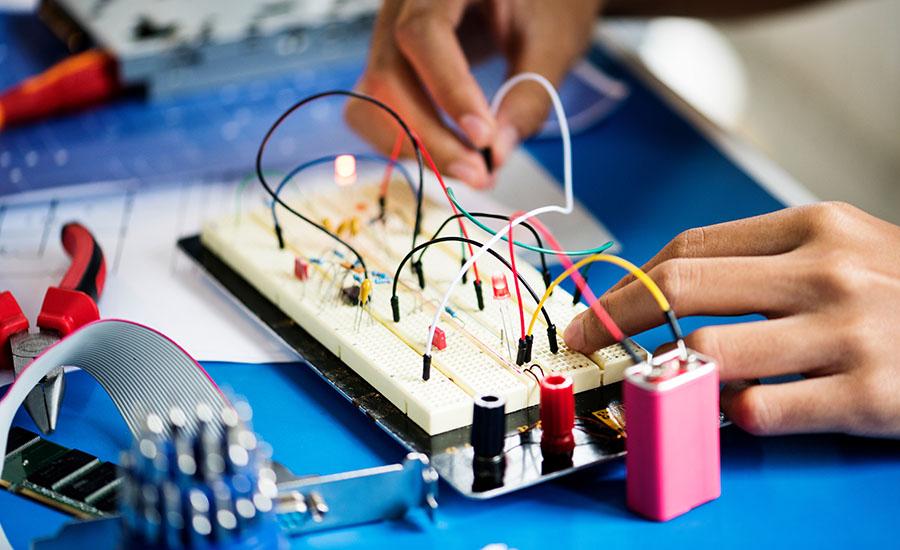
Students will model series and parallel circuits in Tinkercad and transfer the design to a physical breadboard. At the end of the lesson, students must use the design process to design and build a