What's Your Frequency?
The purpose of this lesson is to introduce and apply the concept of frequency.
Students will begin by a motivating “click the mouse” challenge. This will help them to develop the concept of frequency. They will transfer this concept to a hands-on lab where they will be creative and measure various types of frequencies.
The lesson then transitions to sound waves where students learn about how energy can be transferred through air with a given frequency. They learn how to measure this frequency and then use a cell phone app to record their own sound waves and measure the associated frequencies.
Lastly, a set of problems is provided that allows students to further practice the concepts at hand. This lesson will take between 2-3 class periods. Very few supplies are needed
Lesson Plan Link/URL
https://docs.google.com/presentation/d/129rpzuJMrkNVskJkCZekBa2EAXxJQ0rM/edit?u…Subject Area
Science Physical Science P4: Energy Transfer Technology 5. Computational Thinker Mathematics Number and Operations—Fractions (NF) Measurement and Data (MD) Ratio and Proportion (RP) Expressions and Equations (EE) Algebra (A) Reasoning with Functions and Relations (RFR) English Language Arts (ELA) Speaking & ListeningRelated Content
An introduction to Kepler's 1st Law and ellipses. The lesson includes some guided notes for students as well as a hands on activity where students will draw, measure, explore, and conduct calculations
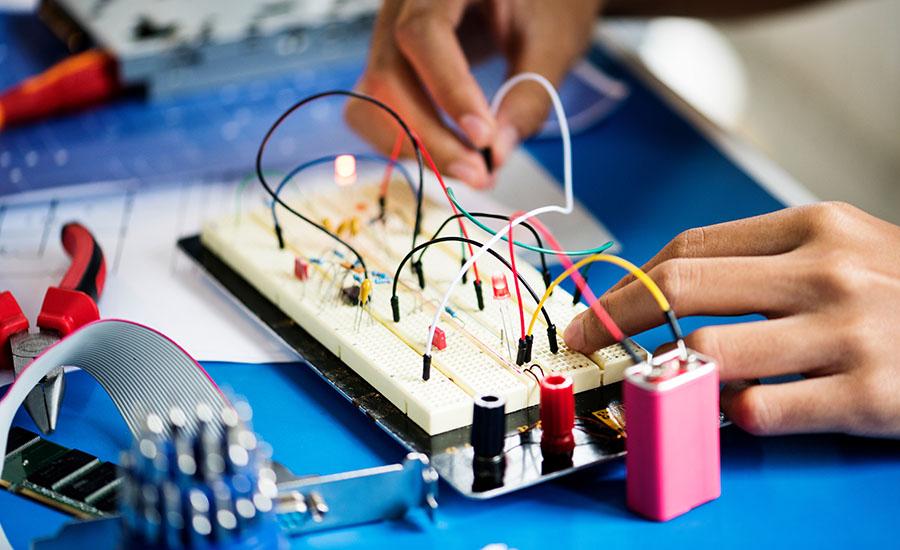
This lesson allows students to describe the amount of current and voltage, and apply their knowledge of Ohm's Law in a series circuits. They do this by using the PhET Constructing Circuits Kit: DC and
This lesson give emphasis on the systems A and B of the chemical reaction that represent the reactants and products. This also focuses on investigating not just the system involved in the chemical